 Alisha Zulfiqar
Have you ever wondered why Facebook Ads for Shopify store owners are such a big deal? Running a store without them is like driving with one eye closed; you’re missing half the road ahead. After managing over $2M in ad spend, I’ve learned that success comes from smart targeting and optimization, not just spending more.
The key to successful Facebook campaigns is smart execution. This can mean the difference between profit and loss. You need the right foundation, targeted audiences, and creatives that focus on conversions. They should work together like a well-oiled machine.
Quick Summary
Master Facebook ads for your Shopify store by starting with Meta Pixel and Conversion API. Create targeted audience segments for prospecting and retargeting. Build a complete conversion funnel from awareness to retention. Then, optimize campaigns using performance data. Focus on ROAS, not just vanity metrics. Test your creative assets often. Use AI tools for better audience targeting and smarter budget allocation.
Why Should You Master Facebook Ads for Shopify?
Mastering Facebook ads for e-commerce helps you find the right customers. It boosts sales and grows your brand quickly. You can turn data-driven strategies into real profits.
The Power of Meta Ads for E-commerce
Facebook and Instagram together reach over 3 billion monthly users. That’s almost half the world’s population checking their feeds every day. Shopify store owners have a unique chance to reach potential customers at every step of their buying journey.
Meta’s advertising platform is great for e-commerce. It blends visual storytelling with precise targeting. Facebook ads differ from Google Ads. While Google captures existing demand, Facebook creates new demand. It shows your products to people who didn’t know they needed them.
What “Mastering” Facebook Ads Truly Means for Shopify Owners
Mastering Facebook advertising goes beyond creating pretty ads and hoping they convert. It means understanding how to create campaigns that make money, build engaged audiences, and plan for steady growth.
In my experience with many Shopify stores, the best advertisers see Facebook ads as a full marketing system, not just a way to drive traffic. They know customer psychology. They use data well and always improve based on performance metrics.
Key Principles for Driving Conversions & ROAS
- Focus on lifetime value, not just first-purchase ROAS
- Build audiences based on behavior, not just demographics
- Test creative assets systematically and refresh them regularly
- Use data to inform decisions, not gut feelings
How Do You Build the Perfect Facebook Ads Foundation?
To build great Facebook Ads, start with clear goals. Set up your pixel correctly. Know your target audience well. This way, every ad can achieve real results.
Setting Up Your Meta Business Suite and Ad Account
Your Facebook Business Manager serves as mission control for all your advertising efforts. Create a business account at business.facebook.com. Then, add your Shopify store’s Facebook Page and Instagram account.
Set your ad account with the right currency and time zone. You can’t change these later without making a new account. I’ve seen too many store owners rush this step only to face headaches down the road.
Meta Pixel & Conversion API (CAPI) Integration
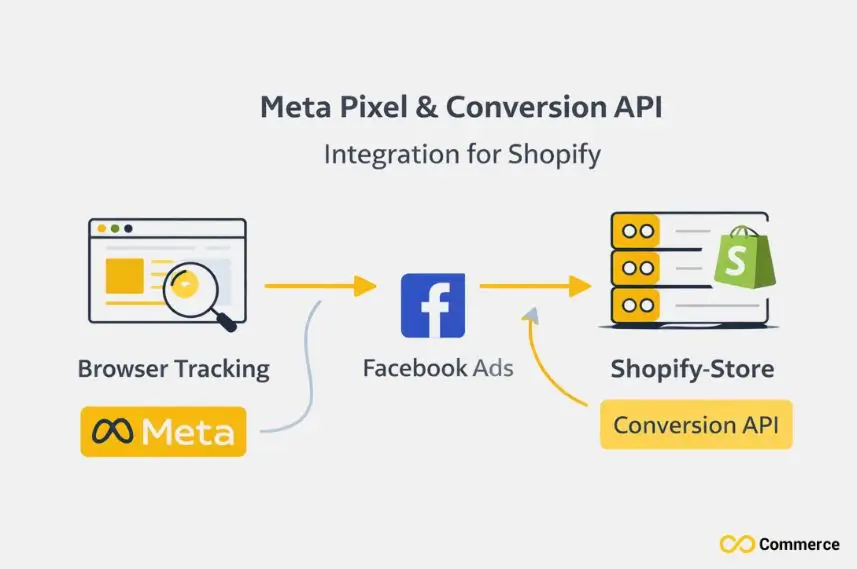
The Meta Pixel is your digital detective. It tracks how visitors behave and sends useful data to Facebook’s algorithm. But with iOS 14.5+ privacy changes, pixel data alone isn’t enough anymore.
Installing the Conversion API with your pixel sets up a backup tracking system. This system captures data from the server side. This dual approach boosts tracking accuracy by 15-20%. This helps optimize campaigns and reduces costs per acquisition.
Here’s how to set it up properly:
- Install the Meta Pixel through Shopify’s Facebook Channel App
- Enable Conversions API in your Meta Events Manager
- Test both implementations using Facebook’s Test Events tool
- Verify that purchase events are firing correctly
Building Your Product Catalog for Dynamic Ads
Your product catalog is key for Dynamic Product Ads. It automatically displays relevant products to people who have engaged with your store. Sync your Shopify product feed with Meta Commerce Manager. This keeps your pricing, availability, and product info accurate.
Dynamic ads often provide 20-30% better ROAS than static ads. This is because they display personalized product recommendations. The key is maintaining clean product data with high-quality images and compelling descriptions.
Seamless Conversion Tracking
Proper conversion tracking extends beyond just the Meta Pixel. Connect Google Analytics to see the full customer journey. Use UTM parameters to track which ads and campaigns bring the best traffic to your online store.
Set up key conversion events for your business. Focus on these primary events: Add to Cart, Initiate Checkout, and Purchase. Use View Content and Search as supporting metrics to help build your audience.
What Audiences Should You Target for Maximum Impact?
To boost your Facebook ads, target audiences similar to your ideal customers. Use lookalike audiences, retargeting, and interest-based segments for the best results.
Prospecting for New Customers
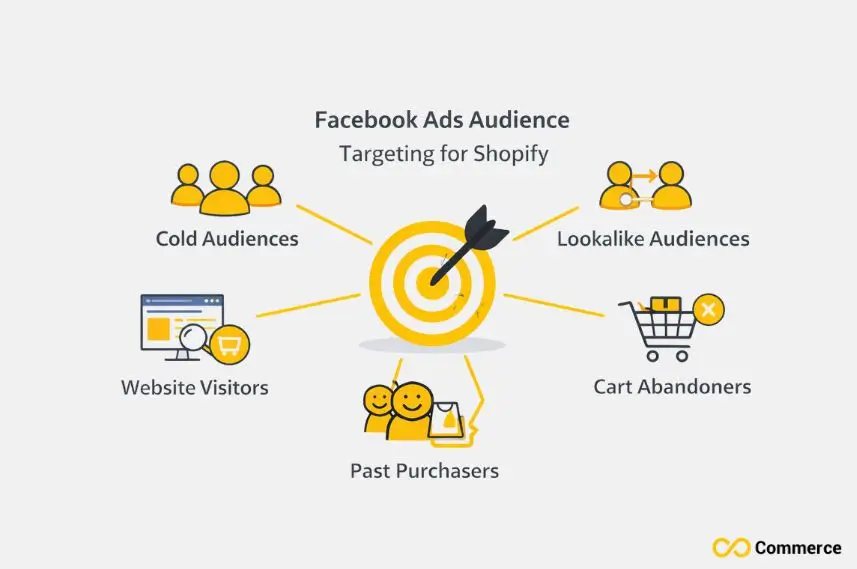
Cold audience prospecting requires a different approach than retargeting warm visitors. Start with Lookalike Audiences using your best customers. Focus on those with the highest Customer Lifetime Value, not just one-time buyers.
Create Lookalike Audiences from these data sources:
- Website purchasers from the last 180 days
- Top 25% of customers by CLV
- Customer file uploads of your VIP buyers
- Add-to-cart events from high-value products
For interest-based targeting, focus on behaviors rather than broad demographics. Target people who interact with competitor pages, follow key influencers, or show buying habits in your product category.
The Retargeting Supercharger
Retargeting campaigns give the best ROAS. This is because you’re connecting with people who already know your brand. The key is segmenting your website visitors based on their actions and intent level.
Create these essential Custom Audiences:
- Website visitors (last 30 days),
- Product page viewers who didn’t purchase,
- Cart abandoners (last 7 days),
- Past purchasers for cross-sell opportunities,
Advanced Retargeting Strategies for Maximum ROAS
Layer your retargeting with strategic exclusions to avoid showing irrelevant ads. Avoid spending your budget on ads for products already purchased. Do this only if you’re promoting related items or consumables.
Use dynamic exclusions in your ad sets. This automatically removes recent buyers. Also, create separate campaigns for different customer segments. First-time buyers need different messaging than repeat customers.
Using Customer Files for Custom Audiences
Upload your customer email list to create Custom Audiences for highly targeted campaigns. First-party data is more valuable now. With third-party cookies fading away, tracking has become tougher.
Your customer file uploads work particularly well for:
- Win-back campaigns for inactive customers.
- VIP product launches for the best customers.
- Cross-sell campaigns based on purchase history.
Which Campaign Types Build the Perfect Conversion Funnel?
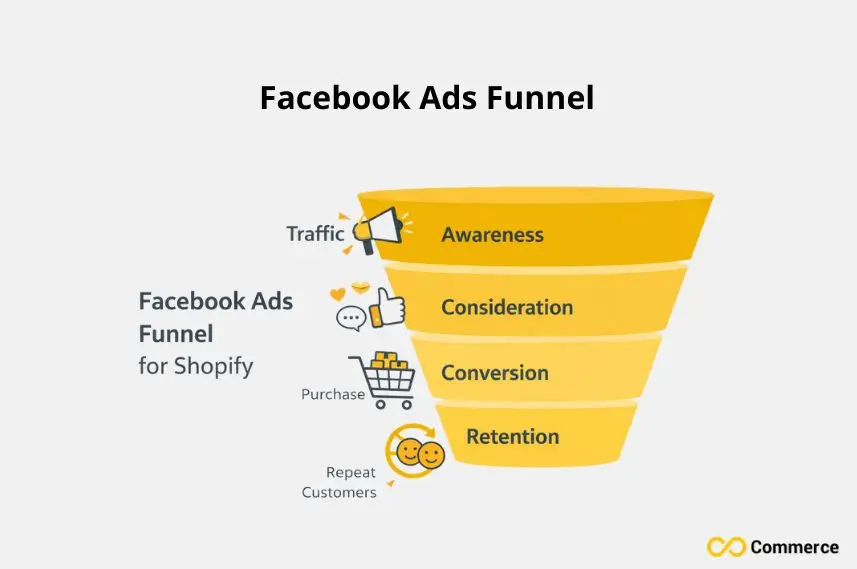
The best Facebook campaign types for a strong conversion funnel are awareness, consideration, and conversion campaigns. They help guide customers from discovery to purchase.
Understanding the Facebook Ads Funnel for Shopify
The Facebook ads funnel mirrors your customer’s journey from discovery to purchase and beyond. Each stage needs unique campaign goals, audiences, and creative methods. These help bring prospects closer to conversion.
Top of funnel campaigns focus on awareness and traffic, introducing your brand to cold audiences. The middle funnel nurtures consideration through engaging content and social proof. Bottom funnel drives direct conversions from warm audiences ready to purchase.
Middle of Funnel (MoFu)
Middle funnel campaigns bridge the gap between initial awareness and purchase intent. Target people who have engaged with your content, visited your website, or shown interest in your products. Focus on those who haven’t converted yet.
Use video ads to show product benefits. Include customer testimonials and behind-the-scenes content. This helps build trust and credibility. Collection Ads are great for this stage. They let prospects browse many products right on Facebook.
Bottom of Funnel (BoFu)
Your bottom funnel campaigns should laser-focus on driving immediate purchases from high-intent audiences. Target cart abandoners, product page viewers, and website visitors from the last 7-14 days. This is when purchase intent is at its peak.
Dynamic Product Ads excel at this stage because they show the exact products people viewed on your site. Use urgent copy and limited-time offers to push prospects to convert quickly.
Post-Purchase & Retention
Don’t stop marketing once someone makes their first purchase. Post-purchase campaigns often bring in 3-5x higher ROAS than cold prospecting. This is because you’re targeting buyers who have already shown interest.
Create retention campaigns that:
- Cross-sell complementary products
- Promote new arrivals to past customers
- Re-engage inactive customers with win-back offers
- Build loyalty through exclusive customer perks
How Should You Create Ads That Actually Convert?
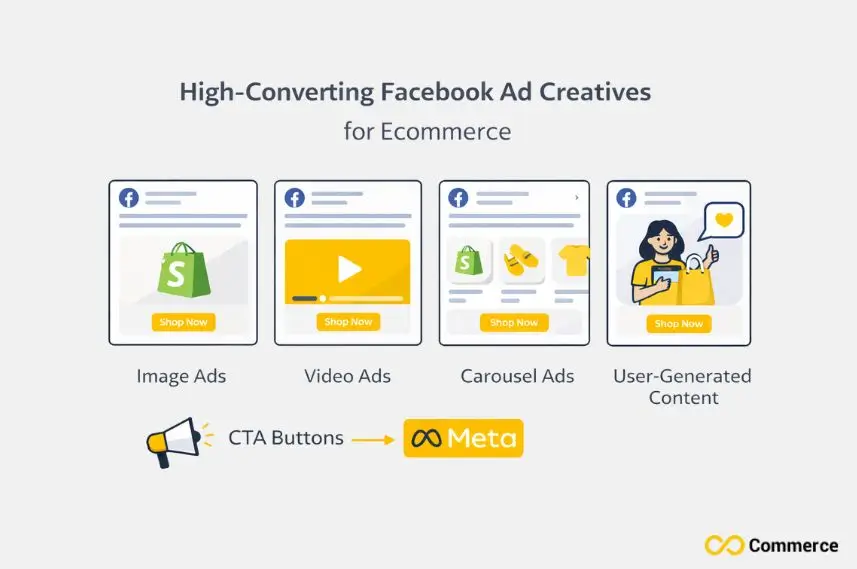
To make Facebook ads that convert, use eye-catching visuals. Keep your messaging clear. Include strong calls to action that connect with your audience’s needs and motivations.
Ad Creative Best Practices for E-commerce
Your creative assets make or break your Facebook ad campaigns. Successful e-commerce creatives use sharp visuals, clear value, and strong calls to action.
Focus on benefits, not just features. Instead of saying “waterproof material,” show someone confidently walking through the rain. Use user-generated content and customer photos when you can. They usually do better than polished studio shots by 20-30%.
Test different creative formats systematically:
- Single image ads for clear product focus
- Carousel Ads for multiple products or features
- Video Ads for demonstration and storytelling
- Collection Ads for immersive browsing experiences
Compelling Ad Copy That Drives Action
Your ad copy should speak directly to your target audience’s pain points and desires. Skip the generic marketing speak and write like you’re talking to a friend who needs your product.
Structure your copy using the AIDA framework: grab Attention with a hook, build Interest with benefits, create Desire through social proof or scarcity, and end with a clear Action. Keep your primary text concise, Facebook truncates longer copy in mobile feeds.
Integrating UTM Parameters for Advanced Tracking
UTM parameters allow you to track ads closely. They show which ads, ad sets, and campaigns bring valuable traffic to your Shopify store. This data becomes crucial when Facebook’s native attribution becomes less reliable.
Standard UTM structure for Facebook ads:
- utm_source=facebook
- utm_medium=paid_social
- utm_campaign=[campaign_name]
- utm_content=[ad_set_name]
- utm_term=[ad_name]
What’s the Best Way to Structure Profitable Campaigns?
The best way to create profitable Facebook campaigns is to focus on clear goals. Start by defining your audience. Then, use tested ad creatives to get the most return for every dollar spent.
Choosing the Right Campaign Objectives for Your Goals
Campaign objectives guide Facebook’s algorithm on the actions you want people to take. This affects who sees your ads and how much you pay. For Shopify stores, focus on these objectives based on your funnel stage:
- Traffic: Top-funnel awareness campaigns to cold audiences
- Engagement: Middle-funnel content promotion and social proof building
- Conversions: Bottom-funnel purchase campaigns (most important for e-commerce)
- Catalog Sales: Dynamic product ads for retargeting
Structuring Your Ad Campaigns for Efficiency and Scale
Organize your account structure logically to make optimization easier and prevent campaign cannibalization. I suggest this structure: create separate campaigns for prospecting and retargeting. Use ad sets for different audience segments. Finally, have ads for various creative options.
Create campaigns like
- Prospecting – Lookalike Audiences
- Prospecting – Interest-Based Targeting
- Retargeting – Website Visitors
- Retargeting – Cart Abandoners
- Customer Retention – Past Purchasers
Budget Allocation: CBO vs. ABO
Campaign Budget Optimization (CBO) allows Facebook to automatically spread your budget across ad sets. In contrast, Ad Set Budget Optimization (ABO) lets you control how much to spend on each ad set.
For most Shopify stores, start with ABO. This helps you find the best-performing audiences. Once you have enough data, switch to CBO. CBO typically improves performance by 10-15% but requires larger budgets to work effectively.
Facebook & Instagram Feeds, Stories, Audience Network
Not all ad placements deliver equal results for e-commerce. Facebook and Instagram feeds usually have the highest conversion rates. Stories, on the other hand, are great for connecting with younger audiences through video content.
Start with automatic placements to gather data, then optimize based on performance. Audience Network usually offers cheaper traffic, but conversion rates are lower. Test it carefully and keep an eye on quality metrics.
How Do You Measure and Optimize for Maximum ROAS?
To boost your ROAS, track key performance metrics. Analyze what works and improve your Facebook campaigns. Focus on better targeting, creatives, and budget allocation.
Key Metrics for Shopify Store Performance
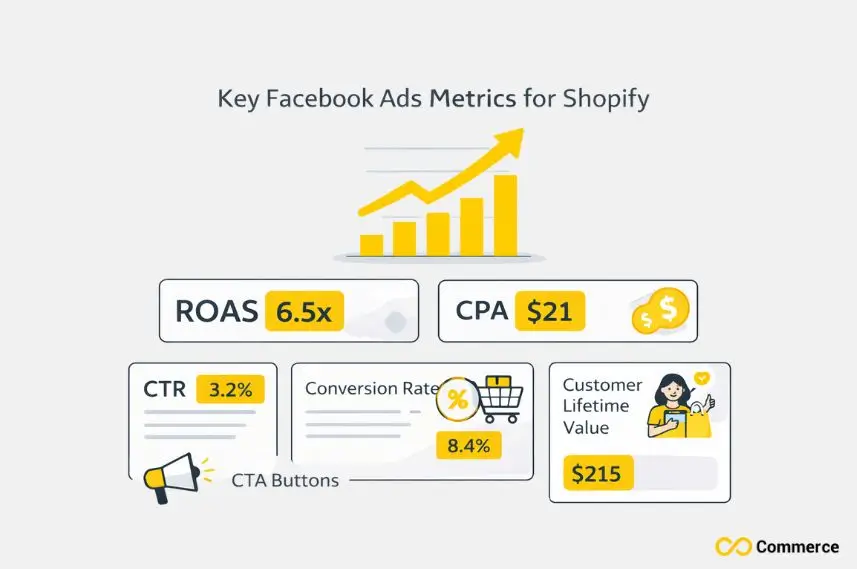
Focus on metrics that directly impact your bottom line, not vanity metrics that look impressive but don’t drive revenue. Return on Ad Spend (ROAS) should be your north star, but understand it within the context of Customer Lifetime Value.
Primary metrics to track:
- ROAS (aim for 3:1 minimum, 4:1+ for scaling)
- Cost Per Acquisition (CPA)
- Click-through rates (CTR) for creative performance
- Conversion rates for landing page optimization
- Customer Lifetime Value for long-term profitability
Deep Dive into Data Interpretation
Raw metrics tell only part of the story. Analyze your data contextually, a 2:1 ROAS might be acceptable if your average customer makes three purchases within six months. Use cohort analysis to understand long-term customer behavior and optimize for lifetime value.
Look for patterns in your best-performing ads, audiences, and campaigns. What messaging resonates most? Which creative formats drive the highest conversion rates? Use these insights to inform future campaign decisions.
Troubleshooting Common Facebook Ads Issues
When campaigns underperform, systematically diagnose the problem. Low click-through rates indicate creative or audience issues. High CTR with low conversion rates suggests landing page problems or audience mismatch.
Common issues and solutions:
- High CPMs: Narrow audiences or ad fatigue, expand targeting or refresh creatives
- Low relevance scores: Mismatched audience and creative, improve targeting alignment
- Cart abandonment: Pricing concerns or checkout friction, optimize your Shopify store experience
Iterative Optimization: The Key to Continuous Growth
Facebook advertising success comes from continuous testing and optimization, not set-it-and-forget-it campaigns. Test one variable at a time, audience, creative, or placement, to isolate what drives improvements.
Implement a structured testing calendar: test new creative assets weekly, audience expansions monthly, and major strategic changes quarterly. Document your results to build an optimization playbook for your specific business.
How Can You Future-Proof Your Facebook Advertising Strategy?
To future-proof your Facebook ads, focus on data privacy. Adapt to algorithm changes and build strong customer relationships. This will help your brand grow over time.
Adapting to the Cookieless Future and Privacy Changes
Privacy-first advertising is here to stay. iOS updates and cookie deprecation are reshaping how we track and target customers. Successful advertisers are adapting. They focus on first-party data collection and server-side tracking.
Strengthen your first-party data strategy:
- Implement email capture throughout your customer journey
- Use post-purchase surveys to gather customer insights
- Build a comprehensive customer database in your CRM
- Focus on customer retention and lifetime value optimization
Leveraging AI for Smarter Campaigns & Higher Conversions
Facebook’s AI continues improving at finding your ideal customers and optimizing delivery. Advantage Plus Shopping campaigns can beat manual targeting. They do this when there’s enough budget and conversion data.
Embrace AI-powered features while maintaining strategic oversight:
- Use Advantage+ Audience for expanded targeting within your parameters
- Test Advantage+ Creative for automatic creative optimization
- Implement Dynamic Ads for personalized product recommendations
- Leverage automated rules for basic campaign management tasks
Staying Ahead: Emerging Trends in Meta Advertising
The advertising landscape evolves rapidly. Stay informed about platform updates, new ad formats, and changing user behaviors. Video content is becoming more important. Short-form videos work especially well for younger audiences.
Monitor emerging trends like
- Interactive ad formats and AR experiences
- Integration with TikTok Ads and other social media platforms
- Enhanced measurement solutions for cookieless tracking
- AI-powered creative generation and optimization tools
Your Roadmap to Sustainable Shopify Growth
Your path to sustainable Shopify growth begins with three key steps: master data-driven marketing, optimize your customer journey, and create long-term strategies. These steps will help boost sales and loyalty over time.
Recap of Key Strategies for Boosting Conversions
Success with Facebook ads for Shopify requires a systematic approach combining technical setup, strategic audience building, compelling creatives, and data-driven optimization. Begin with a strong base using Meta Pixel and Conversion API. Then, build targeted audiences for each funnel stage. Finally, create ads that address your customers’ needs and desires.
Remember that profitable Facebook advertising is a marathon, not a sprint. Build sustainable systems that grow with your business. Avoid chasing quick wins that drain your budget.
The Importance of Continuous Learning and Experimentation
The best Shopify store owners see Facebook advertising as a never-ending learning process. To stay ahead, you must adapt and test continuously. Platform changes, audience behaviors, and competition keep evolving.
Join Facebook ad groups, follow industry experts, and most importantly, test everything in your business. What works for one Shopify store may not work for yours, but the principles and frameworks remain consistent.
Final Thoughts
Start by auditing your Facebook Ads for Shopify stores setup against the foundation elements covered in this guide. Ensure your tracking is accurate, your audiences are well-segmented, and your campaigns align with your business goals. Then, follow a structured testing and optimization schedule to refine your strategy over time.
Remember, success comes from steady, consistent improvements, not big overhauls. Focus on mastering one element before moving to advanced tactics. Treat Facebook advertising as a complete marketing system, and your Shopify store will grow steadily with the right foundation and ongoing effort.
FAQs
Yes, Facebook Ads For Shopify Store are highly effective for driving traffic, boosting conversions, and building brand awareness through precise audience targeting.
Start with $10–$20 per day to test creatives and audiences. Scale your budget once you identify profitable campaigns that generate consistent results.
Combine awareness, consideration, and conversion campaigns to move potential buyers through your sales funnel efficiently.
Yes, $10 a day is sufficient to test performance and gather data. Gradually increase spending as your campaigns begin to perform better.
Use eye-catching visuals, persuasive CTAs, and audience targeting. Track results with the Infinite Facebook Pixel & TikTok Pixel App to optimize conversions and boost ROAS.

